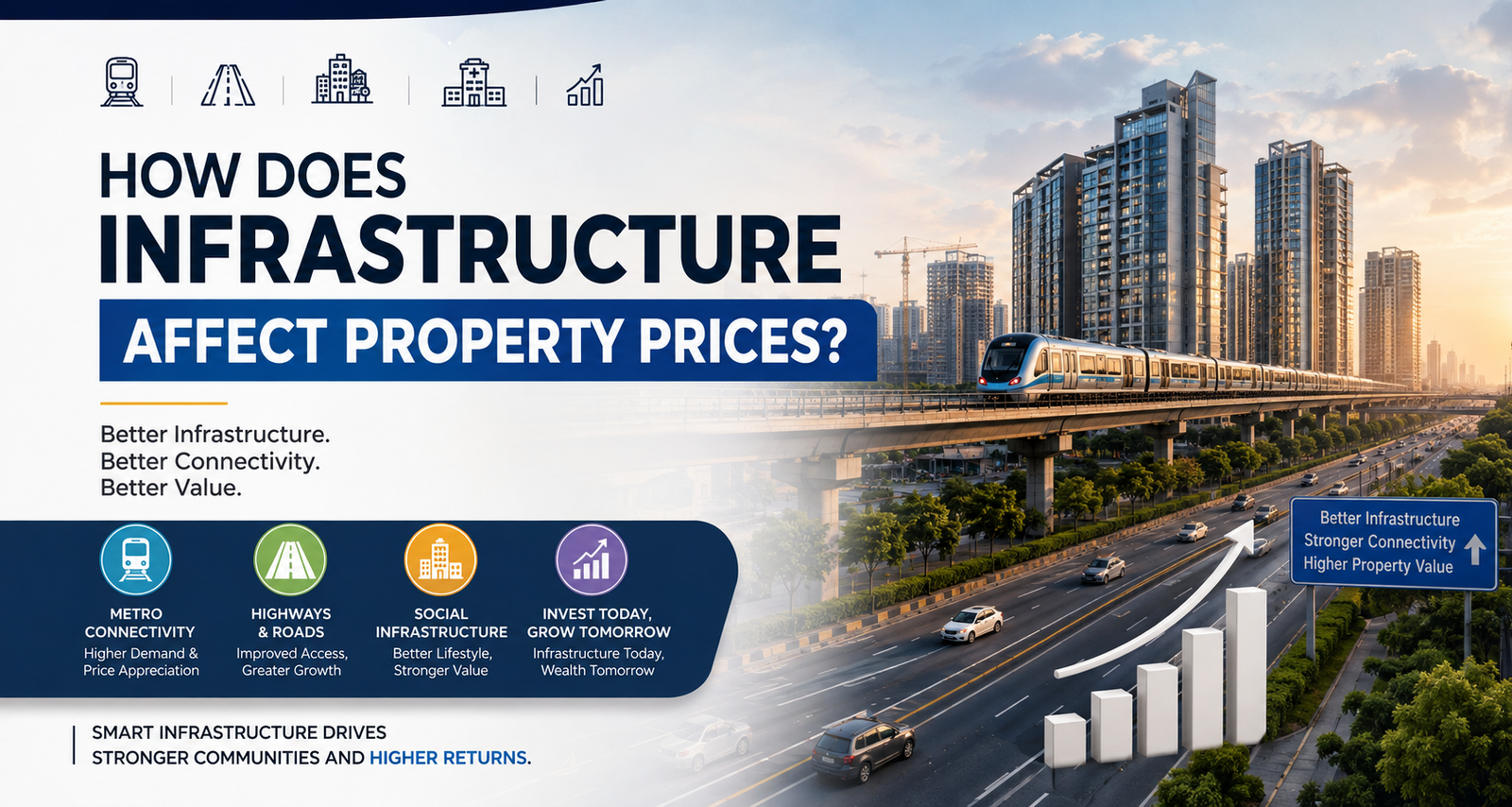
Does infrastructure increase property value? Yes. Infrastructure can significantly influence property prices by improving connectivity, reducing travel time, attracting businesses, and increasing demand for housing. When a locality gains access to better highways, metro networks, railway stations, airports, schools, hospitals, and commercial hubs, it often becomes more attractive to both homebuyers and investors.
The relationship is straightforward: better infrastructure → better connectivity → higher demand → stronger rental potential and appreciation. However, the impact varies by location, project quality, infrastructure completion, and overall demand.
Why Does Infrastructure Increase Property Value?
Infrastructure changes the practical value of a location. A property that was once considered “too far” can become highly desirable when a new transport corridor makes the commute significantly easier.
Improved infrastructure can influence property prices through:
- Reduced travel time: Better roads and public transport make daily commuting easier.
- Higher demand: More buyers and tenants consider the locality accessible.
- Employment growth: Commercial and business hubs create nearby housing demand.
- Rental potential: Professionals often prefer homes with convenient connectivity.
- Future appreciation: Developing infrastructure can support long-term capital growth.
According to a 2026 real estate analysis, properties within 500 metres of metro stations were observed to command a 20–25% price premium, while properties within 1 km showed a 15–18% premium in the analysed markets. These figures are market-specific rather than a guaranteed return, but they illustrate the potential relationship between transit accessibility and property values.
How Does Metro Connectivity Affect Property Prices?
The metro impact on property prices is particularly visible in large Indian cities. Metro connectivity provides predictable travel times and links residential neighbourhoods with employment and commercial centres.
As accessibility improves, properties near stations can attract stronger buyer and tenant interest. Recent reporting on Mumbai's expanding metro network also indicates that station proximity is increasingly influencing homebuyer preferences.
However, being close to a metro station alone does not guarantee appreciation. The surrounding area's roads, social infrastructure, employment opportunities and housing supply also matter.
How Do Highways and Better Connectivity Influence Real Estate?
New highways and expressways can transform peripheral areas into emerging residential and commercial corridors. Better road connectivity can bring suburbs closer to employment centres, airports and established city markets.
The development process often follows a cycle:
Infrastructure → Accessibility → Businesses → Jobs → Housing Demand → Property Appreciation
This pattern can be seen in markets such as Noida and Gurugram. Between 2019 and Q2 2026, reported property prices in Noida increased from ₹4,795 to ₹10,780 per sq. ft.—a 125% rise—while Gurugram recorded a 117% increase during the same period. Infrastructure was one of several factors supporting these markets, alongside employment and urban development.
Which Infrastructure Factors Should Property Buyers Track?
|
Infrastructure |
Potential Property Impact |
|
Metro/Railway |
Better daily connectivity and rental demand |
|
Highways/Expressways |
Wider accessibility and corridor development |
|
Airports |
Business, tourism and commercial growth |
|
Schools & Hospitals |
Higher liveability and end-user demand |
|
IT/Business Hubs |
Employment and rental demand |
|
Retail & Entertainment |
Lifestyle premium |
Does Upcoming Infrastructure Create Appreciation?
It can. Investors often track planned infrastructure because property prices may respond even before a project becomes operational. Announcements, construction milestones and improving investor sentiment can influence demand.
However, buyers should verify whether a proposed project is officially approved, funded and progressing according to schedule. Buying purely on rumours of future infrastructure can increase investment risk.
What Should Investors Check Before Buying?
Before investing in an infrastructure-driven location, consider:
- Existing connectivity rather than relying only on proposed projects.
- Distance from metro stations, highways and railway stations.
- Upcoming employment and commercial centres.
- Schools, hospitals, retail and other social infrastructure.
- Current property prices compared with neighbouring areas.
- Supply of new projects and resale properties.
- Developer credibility and legal approvals.
FAQs
Does infrastructure increase property value?
Yes, infrastructure can increase property value by improving accessibility, attracting businesses and increasing residential and rental demand. Appreciation potential depends on the location and overall market conditions.
Does metro connectivity always increase property prices?
Not necessarily. Metro connectivity can support demand, but appreciation also depends on employment opportunities, social infrastructure, supply, accessibility and overall market sentiment.
Are highways good for property investment?
Well-planned highways and expressways can create new growth corridors by improving connectivity between residential areas, cities and employment hubs. However, investors should assess actual demand rather than relying solely on a highway announcement.
What is the ideal time to invest in an infrastructure-driven location?
There is no universal timing. Investors should look for locations where infrastructure development is credible, connectivity is improving and genuine end-user or rental demand is emerging.
Final Takeaway
Infrastructure is one of the strongest indicators of a property's future potential—but it should not be the only factor. Connectivity, employment, social infrastructure, supply and genuine housing demand collectively determine whether an area can deliver sustainable appreciation.
